








Comment l’IA et le data science transforme l'entreprise ?
La donnée est le moteur du changement : la recherche au sein du Pôle d'Excellence AI, Data Science & Business explore comment l'IA et la data science transforment l'entreprise, de la relation client à la gestion des risques et aux grands défis de société.
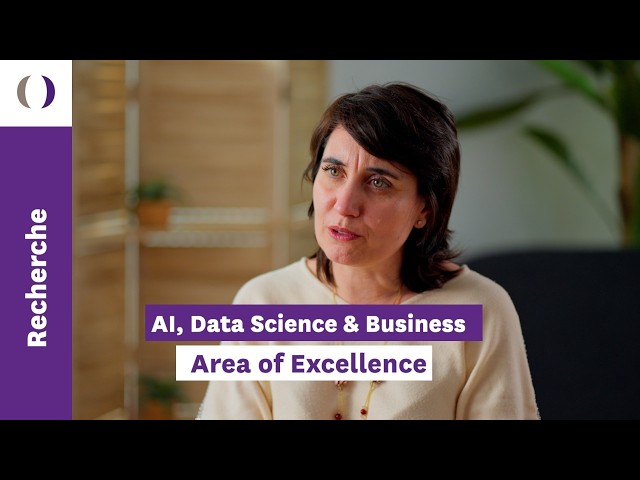
Laura Trinchera présente le pôle d'excellence AI, Data Science & Business
2025
Assefa, D. Z., Ishizaka, A., & La Torre, D. (2025). Exploring the ESG-finance relationship through PROMETHEE ranking. Annals of Operations Research.
https://doi.org/10.1007/s10479-025-06797-0
Bag, S., Gupta, S., Galera‐Zarco, C., & Laguir, I. (2025). Developing green hydrogen‐based regenerative supply chain strategies for a sustainable future : An empirical study. Business Strategy and the Environment, 34(6), 6968‑6990. https://doi.org/10.1002/bse.4334
Bag, S., Routray, S., Rahman, M. S., & Gupta, S. (2025). Digital innovation for circular supply chain sustainability and resilience for achieving carbon neutrality: An empirical study. Journal of Environmental Management, 386, 125665. https://doi.org/10.1016/j.jenvman.2025.125665
Bag, S., Rahman, M. S., Gupta, S., & Lopes De Sousa Jabbour, A. B. (2025). Artificial intelligence driven ethical procurement systems, circular economy and governance: A supplier performance analysis. Journal of Purchasing and Supply Management, 101075. https://doi.org/10.1016/j.pursup.2025.101075
Cantini, A., Coruzzolo, A. M., De Carlo, F., Lolli, F., & Peron, M. (2025). Additive or conventional manufacturing for the management of spare parts inventories? The impact of qualification testing. Production Planning & Control, 36(16), 2223‑2246. https://doi.org/10.1080/09537287.2025.2494096
Chakraborty, K., Adnan, Z. H., Bag, S., & Gupta, S. (2025). A study on pricing, emission reduction, and innovative digital investment strategies for competitive or cooperative EV supply chains. Journal of Cleaner Production, 512, 145239. https://doi.org/10.1016/j.jclepro.2025.145239
Chaudhuri, N., Gupta, G., & Popovič, A. (2025). Do you believe it? Examining user engagement with fake news on social media platforms. Technological Forecasting and Social Change, 212, 123950. https://doi.org/10.1016/j.techfore.2024.123950
Chaudhuri, N., Gupta, G., & Popovič, A. (2025). Do you believe it? Examining user engagement with fake news on social media platforms. Technological Forecasting and Social Change, 212, 123950. https://doi.org/10.1016/j.techfore.2024.123950
Chen, L., Han, S., Gupta, S., Sivarajah, U., & A. Yamoah, F. (2025). A novel untapped flight segment flow prediction framework based on graph deep learning and heuristic algorithm for sustainable transport development. Journal of the Operational Research Society, 76(7), 1338‑1354. https://doi.org/10.1080/01605682.2024.2433191
Deng, H., Huang, Z., Wu, J., Güneri, F., Shen, Z. Y., & Yu, C. (2025). Harnessing the power of industrial robots for green development: Evidence from China’s manufacturing industry. Technological Forecasting and Social Change, 215, 124099. https://doi.org/10.1016/j.techfore.2025.124099
Goldani, N., Ishizaka, A., Kazemi, M., & Khan, J. (2025). Enhancing pairwise comparisons for multi-criteria decision making : Application to healthcare waste management. IMA Journal of Management Mathematics, 36(4), 759‑793. https://doi.org/10.1093/imaman/dpaf020
Gupta, S., Modgil, S., Lopes De Sousa Jabbour, A. B., Laguir, I., & Stekelorum, R. (2025). Towards digital transformation and governance in the healthcare sector. Information Technology & People, 38(5), 2163‑2186. https://doi.org/10.1108/ITP-02-2023-0179
Gupta, S., Modgil, S., Tuunanen, T., Zhang, Z., & Ali, I. (2025). Blockchain‐based innovation in platforms for user‐centricity and transparency. R&D Management, 55(5), 1683‑1702. https://doi.org/10.1111/radm.12780
Gupta, S., Modgil, S., Tuunanen, T., & Kar, A. K. (2025). Transitioning to ai-enabled generative cyber-physical servicescape. Information Systems Frontiers. https://doi.org/10.1007/s10796-025-10616-z
Gupta, G., & Chaudhuri, N. (2025). Decoding GenAi assimilation in teams: A multi-method study of GenAi’s impact on collaborative performance in project-based work. Information Systems Frontiers. https://doi.org/10.1007/s10796-025-10646-7
Krishankumar, R., & Ishizaka, A. (2025). Solar panel prioritization with a combined multi-criteria approach including hyperbolic fuzzy set. Annals of Operations Research. https://doi.org/10.1007/s10479-025-06798-z
Krishna, P., Majumdar, A., & Bose, I. (2025). All that glitters is not code? Understanding the predictors of developer popularity and sponsorship on a social coding platform. Production and Operations Management, 10591478251405119.
https://doi.org/10.1177/10591478251405119
Kucukkoc, I., Finco, S., Peron, M., & Aydin Keskin, G. (2025). Including mechanical requirements in a bi-objective nesting and scheduling model for additive manufacturing. European Journal of Operational Research, 325(3), 416‑432. https://doi.org/10.1016/j.ejor.2025.03.022
Larsen, K. R., Mueller, R. M., Bonaretti, D., Fischer-Preßler, D., Burleson, J. (Jim), Singh, N., Parsons, J., Pillet, J.-C., Sang, L., & Zhang, Z. (Drew). (2025). The item ontology: A tool to elucidate the anatomy of psychometric indicators. Information Systems Research, isre.2023.0257. https://doi.org/10.1287/isre.2023.0257
Leoni, L., Peron, M., & De Carlo, F. (2025). Machine learning-based predictive maintenance: Empirical insights of challenges and countermeasures. Production Planning & Control, 1‑30.
https://doi.org/10.1080/09537287.2025.2555924
Liang, Y., Qin, J., & Ishizaka, A. (2025). Assessment of digital economy development with the new multicriteria sorting method: DCMSort. Omega, 132, 103224. https://doi.org/10.1016/j.omega.2024.103224
Lin, W., Wang, Y., Zhang, Q., Peron, M., & Lu, J. (2025). Emerging opportunities or paradoxes : Assessing the effect of digital technology adoption on corporate carbon performance. Journal of Environmental Management, 391, 126399. https://doi.org/10.1016/j.jenvman.2025.126399
Lolli, F., Coruzzolo, A. M., Forgione, C., Peron, M., & Sgarbossa, F. (2025). Auto-AzKNIOSH : An automatic NIOSH evaluation with Azure Kinect coupled with task recognition. Ergonomics, 68(10), 1718‑1734. https://doi.org/10.1080/00140139.2024.2433027
Lolli, F., Coruzzolo, A. M., Peron, M., & Sgarbossa, F. (2025). Insourcing additive manufacturing for spare parts production : Is it profitable? An extensive analysis and the proposal of a Decision Support System. International Journal of Production Research, 63(11), 3961‑3981. https://doi.org/10.1080/00207543.2024.2432470
Lopes De Sousa Jabbour, A. B., Laguir, I., Stekelorum, R., & Gupta, S. (2025). The nexus of artificial intelligence and sustainability performance : Unveiling the impact of supply chain transparency and customer pressure on ethical conduct. Journal of Environmental Management, 379, 124847. https://doi.org/10.1016/j.jenvman.2025.124847
Markovic, S., Iglesias, O., Torres, A., Rivera‐Torres, P., & Koporcic, N. (2025). Unpacking the relationship between co‐creation and brand equity: A multi‐study approach. European Management Review, emre.70030. https://doi.org/10.1111/emre.70030
Modgil, S., Gupta, S., Kar, A. K., & Tuunanen, T. (2025). How could Generative AI support and add value to non-technology companies – A qualitative study. Technovation, 139, 103124. https://doi.org/10.1016/j.technovation.2024.103124
Müller, S. D., Zaggl, M., Svangaard, R., & Jakobsen, A. M. (2025). Digital Transformation Toward Data-Driven Decision-Making: Theorizing Action Strategies in Response to Transformation Challenges. Communications of the Association for Information Systems, 56, 961-999. https://doi.org/10.17705/1CAIS.05637
Pattanaik, P. K., Gupta, S., Pani, A. K., Himanshu, U., & Pappas, I. O. (2025). Impact of inter and intra organizational factors in healthcare digitalization: A conditional mediation analysis. Information Systems Frontiers, 27(3), 1275‑1302. https://doi.org/10.1007/s10796-024-10522-w
Sahoo, S., Kumar, A., Mangla, S. K., & Ishizaka, A. (2025). Examining the effects of industry 4. 0 adoption, information acquisition capability, and organizational ambidexterity on innovation and circular economy performance. Business Strategy and the Environment, 34(2), 1590‑1606. https://doi.org/10.1002/bse.4067
Sbrana, G., & Silvestrini, A. (2025). The structural Theta method and its predictive performance in the M4-Competition. International Journal of Forecasting, 41(3), 940‑952. https://doi.org/10.1016/j.ijforecast.2024.08.003
Sbrana, G. (2025). Markov Walk and Walmart sales prediction. Journal of the Operational Research Society, 1‑12. https://doi.org/10.1080/01605682.2025.2569661
Sedighi‐Maman, Z., Gupta, A., Wilkerson, G. B., & Popovič, A. (2025). Machine learning approaches for improved understanding of factors associated with history of sport‐related concussion. Risk Analysis, risa.70061. https://doi.org/10.1111/risa.70061
Sègbotangni, E. A., Laguir, I., & Gupta, S. (2025). Exploring the effect of supply chain integration and supply chain transparency on SME environmental performance under conditions of environmental unpredictability. Journal of Environmental Management, 375, 124225. https://doi.org/10.1016/j.jenvman.2025.124225
Trinh, T. (2025). The effect of modern information technology on corporate payout policy. Evidence from EDGAR implementation. Journal of Economic Studies, 52(5), 872‑886. https://doi.org/10.1108/JES-05-2024-0366
Tsirozidis, G., Kirk, U. B., & Zaggl, M. A. (2025). Benefits for thee, not for me? mHealth engagement through the lens of privacy calculus theory and trust. Behaviour & Information Technology, 44(19), 4663‑4683. https://doi.org/10.1080/0144929X.2025.2485395
Yang, F., Qian, Y., & Xie, H. (2025). Addressing endogeneity using a two-stage copula generated regressor approach. Journal of Marketing Research, 62(4), 601‑623. https://doi.org/10.1177/00222437241296453
Zaggl, M. A., Block, J., & Wissel, J. (2025). Certification of open source software compliance: Insights from a conjoint experiment. Information Systems Journal, isj.70014. https://doi.org/10.1111/isj.70014
Zhang, S., Chen, R., Wu, J., & Zhu, N. (2025). Scale measurement and economic effect evaluation of smart agriculture in China. Socio-Economic Planning Sciences, 99, 102195. https://doi.org/10.1016/j.seps.2025.102195

Key Facts
- + de 50 projets de recherche
- + de 20 bourses internes et externes
- + de 30 professeurs travaillant sur des projets
- 104 cours
- Institut SPOC
Chairs, partners and financed projects